Friday, October 20, 2017

What You Need to Know About Your DSC-VHF Radio When Buying or Selling a Boat


If a boater has an emergency on the water, there’s no better way than to call for help than with a Digital Selective Calling (DSC) VHF radio which can give rescuers critical GPS location information. But that doesn’t mean these technologies come without a few quirks, especially when buying or selling a boat with DSC-VHF radios aboard. Boat Owners Association of The United States (BoatUS) has some practical advice to ensure that when you do need help, it arrives as quickly as possible.


The MMSI issue: DSC-VHF radio-equipped vessels must be registered and issued a Maritime Mobile Service Identity (MMSI) number that is then entered into the radio. Unlike a phone number that stays with you when you move across town, a boat’s MMSI always stays with the boat, so any subsequent owner must update the MMSI number with his or her new contact information. To make this easier, print a copy of your MMSI certificate, write down your registration login name and password and keep it in a safe place. This will make managing your boat’s MMSI easier if any registration details change or when it is sold to a new owner.

Hand-held DSC-VHF radios – who should get them when the boat is sold? Some boaters have both fixed-mount and hand-held DSC-VHF radios aboard, and both can share the same MMSI number. When selling, it’s wise to include any hand-held DSC-VHFs in the purchase and not take them with you to the new vessel. It would be dangerous to have the same MMSI being used by more than one vessel, and hand-held DSC-VHF radios often need to be sent to the manufacturer for a “factory reset” before they can be updated with a new MMSI number – a time-consuming process.

The international quirk: It’s OK to use your DSC-VHF radio for communications purposes when transiting foreign waters. Once you communicate with or enter a foreign port (“foreign station”), however, a US-registered boat must have a federal Ship Station License. These are only issued by the Federal Communications Commission, which also provides an appropriate internationally accessible MMSI number as part of the $220 Ship Station License fee, good for 10 years. The benefit of receiving an MMSI from the FCC is that your emergency contact information goes into an internationally accessible database (also accessible to the US Coast Guard), potentially speeding a foreign rescue. MMSI numbers not issued by the FCC are only entered into the US Coast Guard database used for domestic waters. Boaters can learn more at the BoatUS Foundation for Boating Safety and Clean Water’s free online DSC-VHF radio tutorial.

DSC-VHF radio and Automatic Identification System (AIS): While both use the vessel’s same MMSI number when it comes to registration, DSC-VHF radio and Automatic Identification System (AIS) do not share any other relationship, and each has a completely different process to follow when buying and selling a boat, or potentially when changing a boat’s name (an AIS requirement).

BoatUS offers an easy online MMSI registration for $25 that makes obtaining an MMSI number simple, adds an extra layer of safety by partnering with the US Coast Guard to share information, and offers valuable boater benefits. This registration fee includes complimentary BoatUS membership. Go to BoatUS.com/MMSI for more.

Thursday, October 20, 2016

Pennsylvania Mandatory Life Jacket Requirement Starts November 1

When sunny days and fall foliage tempt the boater in you, don’t forget about your life jacket, especially if you are planning to use a canoe, kayak or similar small boat.
 
The Pennsylvania Fish and Boat Commission (PFBC) is reminding boaters that beginning November 1 and lasting through April 30, they are required to wear a life jacket while underway or at anchor on boats less than 16 feet in length or on any canoe or kayak. The requirement applies to all Pennsylvania waters.
 
“Life jackets are the most important piece of safety equipment on a boat,” says Ryan Walt, PFBC Boating and Watercraft Safety Manager. “According to Pennsylvania’s boating accident reports, almost 80 percent of all boating fatalities happen to boaters not wearing a life jacket. A disproportionate number of the fatalities occur during the months of November through April. During these cold weather months, boaters are especially at risk due to the water temperature and the risk of sudden cold water immersion.” 
 
 
When a person is unexpectedly plunged into cold water below 70ºF, the body’s first response is usually an involuntary gasp. Without a life jacket, a victim may inhale while under water and drown without coming back to the surface. If an individual does make it back to the surface, his ability to swim is usually restricted because of a shortness of breath or hyperventilation.
 
Individuals who plan to fish, boat or hunt from a boat this fall or winter are encouraged to follow these cold water survival safety tips:
  • Always wear a life jacket, even when not required. Many models also offer insulation from cold air. Read the life jacket’s approval label to be sure it’s appropriate for your boating activity.
  • Never boat alone.
  • Leave a float plan with family or friends and know the waters you plan to boat.
  • Bring a fully charged cell phone with you in case of emergency.
  • Wear clothing that still insulates when wet, such as fleece, polypropylene or other synthetics.
  • If you are about to fall into cold water, cover your mouth and nose with your hands. This will reduce the likelihood of inhaling water.
  • If possible, stay with the boat. Get back into or climb on top of the boat.
  • While in cold water, do not remove your clothing.
  • If you can’t get out of the water, get into the Heat Escape Lessening Posture (HELP). In this position, individuals bring their knees to their chest and hug them with their arms.
  • Once out of the water, remove wet clothes and warm up as soon as possible.
  • Seek medical attention when necessary. Some effects of exposure to cold temperatures can be delayed.
To learn more about life jacket wear and cold water survival, visit the Water Safety page and the “Wear It Pennsylvania” page.

Tuesday, October 4, 2016

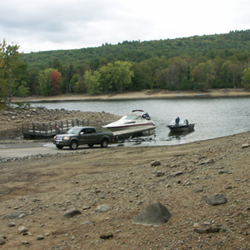
New York Alerts Boaters to Low Water Levels at Many Boat Launches

Low water at boat launch 

Due to the ongoing drought conditions in New York State, many waters are significantly below average water levels for this time of year. While many DEC boat launches are still useable by shallow draft boats, boaters desiring to launch larger, deeper draft waters may have difficulties on many waters. Of particular concern are DEC boat launches on Oneida Lake, Lake Champlain, Great Sacandaga Lake and Chautauqua Lake. On Great Sacandaga Lake, boaters desiring to launch larger vessels should use the Northville ramp which currently provides 4 ft. of water depth at the end of the ramp. On Lake Champlain, which is a foot below normal water level elevations for this time of year, most launches currently provide 3.0 ft of water depth. Exceptions are the Ticonderoga Launch which is currently below this level at 2 ft. Water levels at the Lake Ronkonkoma Boat Launch in Suffolk County, the Redfield Island Boat Launch on the Salmon River Reservoir in Oneida County and many Susquehanna River launches in DEC Region 7 are currently below the concrete launch ramp. Boaters, particularly those desiring to launch larger, deeper draft boats, are encouraged to contact the DEC regional office covering the water they desire to launch their boat onto for updated information.


Friday, May 20, 2016

2016’s Top Ten Boat Names

What’s in a Boat Name?
BoatUS Releases 2016’s Top Ten Boat Names

ALEXANDRIA. Va., May 18, 2016 -- A boat name can reveal much about the personality of a boat owner. Are they into fishing? Reel Therapy on the boat’s transom certainly shows it. Do they have kids in school? What College Fund? says it best. Like to sing? In Harmony is a popular choice. Work in the finance industry? Liquid Assets is suitable

Regardless of lifestyles, families or careers, choosing a name can be difficult. To help boaters with this task, Boat Owners Association of The United States (BoatUS) offers a list of over 9,000 boat names given by boaters across the country over the last 20 years, and today officially releases it’s 2016 list of Top Ten Boat Names. They are:

1. Happy Ours
2. Freedom
3. Grace
4. Serendipity
5. Island Time
6. No Regrets
7. Liberty
8. At Last
9. Blue Moon
10. Aqua holic

Happy Ours may be the most popular boat on a Friday night at the marina,” said BoatUS Boat Graphics Manager Greg Edge. “Names like Freedom and Liberty show boaters’ patriotic side, but they also like their boat names to remind themselves to slow down and relax, such as the ever-popular Island Time.”

For a look at all of the boat names, go to BoatUS.com/boatnames. The BoatUS Graphics service offers an online design tool to easily create custom boat graphics with fast turnaround times. All graphics come with a 30-day “Oops Assurance Guarantee” that allow a buyer to receive replacement decals free of charge if the graphic was damaged during installation. Simple video instructions show how to remove or add graphics.

For more, go to BoatUS.com/boatnames

Saturday, April 23, 2016

Four Myths About Boat Fire Extinguishers


Every spring, the BoatUS Foundation for Boating Safety and Clean Water receives questions from boaters about fire extinguishers. To help set the record straight here are four fire extinguisher myths debunked:

Myth #1: Tapping or striking the extinguisher keeps the contents “fresh”.
Reality: Leave the mallet at home. Unlike days of old, today’s modern fire extinguishers don’t use chemicals that cake, get hard, or need to be broken up. Whacking it with a mallet or hammer could compromise the extinguisher’s ability to put out a fire.

Myth #2: All extinguishers must be mounted with a bracket.
 Is this fire extinguisher ready to put out a fire.
Reality: Mounting a fire extinguisher on a bracket keeps the unit in a handy place and may protect it from being banged around the boat, but it is not a legal requirement. You do, however, need to ensure the extinguisher is readily accessible, so leaving it at the bottom of locker or compartment is a big no-no.

Myth #3: Fire extinguishers get old and go “bad” every year.
Reality: Unlike flares, fire extinguishers have no expiration date. To meet US Coast Guard carriage requirements however, the extinguisher must be Coast Guard approved and in “good and serviceable” condition. The charge indicator needs to be in the green zone, the nozzle free of obstruction and the cylinder not rusted.

Myth #4: The law says you only need to carry one extinguisher.
Reality: US Coast Guard minimum equipment requirements dictate that larger vessels require more than one fire extinguisher. While a full list of all minimum safety gear requirements for all boat sizes can be found at BoatUS.org/equipment, don’t let that stop you from adding additional extinguishers. Having back-ups may help save your boat and won’t break your budget.

Tuesday, December 22, 2015

New Powerboat Registrations Up

Over 8% increase in third quarter 2015

The National Marine Manufacturers Association reports in the third quarter of 2015, new registrations of traditional powerboats and personal watercraft were up 8.5% (YOY) and up 8.8% (R12M YOY).

Jet drive boats, personal watercraft, wake sport boats, and outboard boats led growth, up 22.3%, 14.3%, 10.6% and 8.2% (R12M YOY) respectively. There’s continued softness in sterndrive boats, down -7.5% (R12M YOY), while inboard cruisers were relatively flat, up 0.1% R12M YOY.

Among high-volume regions, growth was led by the Pacific region, which spans the Pacific coast from Washington to California including Hawaii (up 11.3% R12M YOY). The South Atlantic region, which spans the Atlantic Coast from Delaware south to Florida was up 10.8% R12M YOY and the East North region, which includes Indiana, Michigan, Ohio, and Wisconsin, was up 8.8% R12M YOY. Together, these regions represent 47.4% of all new boat sales.

Monday, December 7, 2015

America’s Boating Safety and Angling Conservation Reauthorized

In a victory for boaters and anglers, Friday’s passage of the Fixing America’s Surface Transportation (FAST) Act also includes reauthorization of the Sport Fish Restoration and Boating Trust Fund through the year 2020. After significant lobbying by Boat Owners Association of The United States (BoatUS) along with other boating and angling organizations, in 1984 Congress passed legislation establishing what was then called the Wallop/Breaux Trust Fund. Now called the Sport Fish Restoration and Boating Trust Fund, it continues to serve as the backbone of boating safety, infrastructure, clean water and fisheries conservation funding in the United States.

The practical “user pay, everyone benefits” program uses federal boat fuel and fishing tackle taxes to protect natural aquatic resources, enhance boating safety and provide more recreational fishing and boating opportunities. Since its inception, more than $7.5 billion has been collected and allocated to the states. More recently since 2004, over 3.8 billion fish have been stocked, 11,000+ boat ramps and access sites have been created or renovated and over 1,100+ transient boating facilities built, 4.7 million students taught aquatic education, over 63,000 acres of fish habitat protected, and over half a million boaters, sailors and anglers have completed an approved state boating safety education course.

BoatUS, as a longtime champion of the Trust Fund along with other members of the Angling and Boating Alliance (ABA), has worked tirelessly to make certain it continues to be used for key boating and fishing programs. Said BoatUS President Margaret Podlich, “Some in Washington might have viewed these boater and angler tax dollars as a way to solve their own budget problems. BoatUS along with the ABA made certain this reauthorization ensures that the money boaters and anglers pay stays intact for the intended use: saving lives, keeping our fish stocks healthy and making it easier to enjoy the water.”

Podlich went on to state, “We appreciate the leadership of the multiple House and Senate Committees that included the Trust Fund in the FAST Act. Congressman Bill Shuster, Senator James Inhofe, Congressman Peter DeFazio, Senator Barbara Boxer, Senator John Thune and Senator Bill Nelson are all to be commended for their continuing support of America’s boaters and anglers.”